Interview: Margherita Ferrari

We interviewed director Margherita Ferrari about her feature debut, “Föa - Once Upon a Future”.
The film centres on the protests surrounding the 2001 G8 summit in Genoa. However, it would be reductive to approach the film solely through the lens of the Genoa G8 protests. Set against this historical backdrop, this story explores how political violence infiltrates private life, the dramatic function of space, and a young woman’s bodily autonomy.
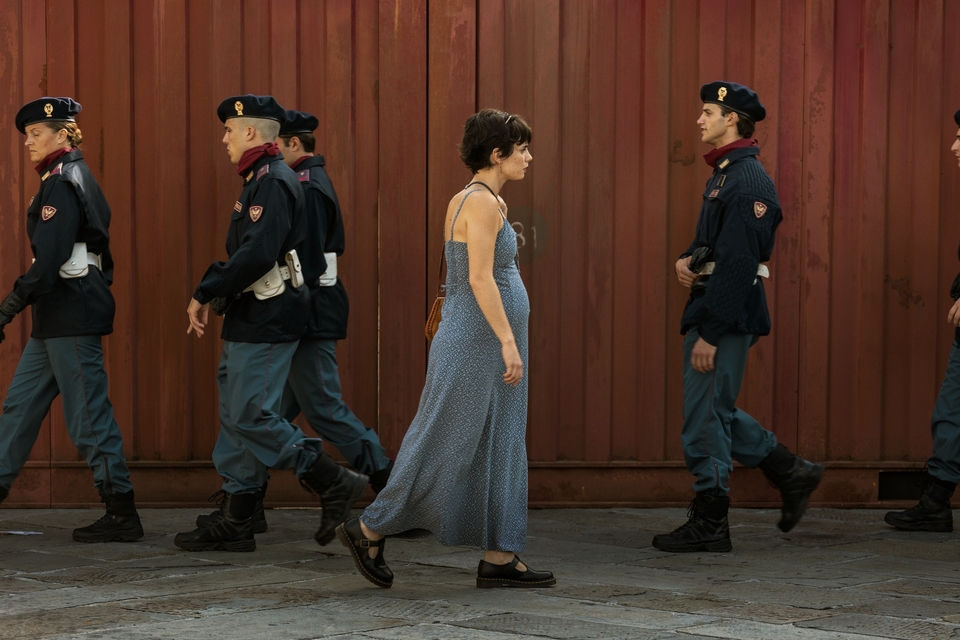
Ferrari revisits her 2023 short film, rewriting and directing it as a feature. The contrasts in the film are crucial, and they become much more pronounced in the feature-length version. Nicole (Gaia Ravina) is pregnant, meaning her relationship with the future is tied to her own body. Yet, as a historical rupture unfolds outside, she remains inside the house. When she opens the door, the political struggle outside and her personal life inside become intertwined. The scene thus becomes more than a mere encounter.
The film had its world premiere in the Flash Forward section of the Busan International Film Festival this year. Starring Gaia Ravina and Pietro Giannini and it was produced by Numero 10 and The Apartment.

How did this story begin? And what made you want to tell this story?
So, everything was born with the short movie, actually, that I think that you saw. But from the beginning, everything was born from a childhood memory, because I have one single memory of those days, in particular of the day where the story is set. So, on the 20th of July of 2001. And so I remember I was very young at the time, and I remember just one thing that was the closed window of my living room. Because, it was summer, so it was really hot in those days, but despite that we had to put all the windows closed because of all the sound outside and also the smoke of the tear gas and stuff. And so this sensation of staying closed in my own home while outside something bigger than me was happening impressed me quite a lot. And actually, I remembered that while I was at home during COVID. And yeah, this contrast between my intimate life, my loneliness, and something really collective and big outside, I think it's something that sounds to me about a really contemporary image about the world today. So yes, more or less was born from that.
One of the things I loved most about the short film and also the feature one was how you used space. The house gradually becomes much more than just a setting. How did you approach the relationship between the domestic space and the political events unfolding outside?
Thank you for asking this question because I loved it. Beyond the narrative heart of the film, which I think has a lot to do with writing, I think that this question is very much about directing. So for me, directing works through a language of images and of connection that I see between images. And so it's a very more emotional, dreamlike way of thinking and of creation. And so sometimes I only understand, like, the meaning of those connections afterwards. And so yes, once again thanks for the question, because I find that interesting to reflect on that. So from the beginning, I imagined the film, the movie, taking place in a house, and it's a house that contains a lot of memories and childhood detail, also from my childhood, because I was very young at the time, and so this allowed me to put a lot of small historical details into the space, such as the telephone or the bookphone, stuff like that, or the poster of Titanic. So also the house is full of doors, because they connect different spaces, and more private spaces, such as the bedrooms, and more intimate spaces, like the bathroom, where the mother hides and the girls talk etc.
Also the doors connect the domestic world from the outside. And at the people, the peephole, it's the moment when Nicole can look into the eyes of this other character, which is Irene, and almost as if she were watching a movie, the movie enters into her house, and that's a really important moment to me, because from that moment we don't see just details in the house about the historical moment, but we can catch the character into the relationship with the protesters, and the taste of what's happening outside, and we can put more writing about the outside, not just the space is occupied by the characters. Also another thing, I think is really important to me in this space: the windows, because of the little memory that I was telling you, and also because they create this feeling of darkness and claustrophobia inside the house. And I think in July it's extremely hot, and they have to stay closer to each other, and so the windows helped me with this relationship. And somehow this made me think about Nicole's belly. I mean this hot space, but with darkness, reminded me of a womb, like a mother's belly. And so the house becomes more like a womb, and it had dragged me, because it's a coming-of-age story, and it's also a story about a girl becoming an adult, but it's also about a child who is about to be born. So at first the outside world only reaches the house with sounds, and with echoes. But from a center point, when we go to the terrace outside, there is a lot of light and real footage material about the time. So that's the moment when we can put reality in our fictional story. And so that's the moment, I think, where the space of the house can meet the space of the outside for real. I shared you a lot of ideas that I had now, but of course during the creative process I had to transform all these ideas into concrete direction that I had to give to every department. And so production design, sound design, editing, and everyone tried to shape the space from it.
I'm interested in how Nicole's pregnancy shapes the story. Did you see her pregnancy primarily as a personal circumstance, or did it also influence the way you approached the film's political dimension?
It’s a beautiful question again. The idea came from the fact that my mother was pregnant when she was 18 years old, and she was really young. And so this was the image that I had in my head. But it became more powerful as an image because of the political meaning, I think, that can have this image, you know, as a metaphor. Because Nicole, like, embodies the question of the future. I mean, I'm not a mother, I'm just... But I have, of course, the question about maybe I can become a mother in my future, maybe not, or maybe yes. So to me, pregnancy right now in this period of my life is something more about, not about motherhood, but it's more about the question. And I think that Nicole is a symbol of these questions. She is just an 18 years old with all this future in front of her and inside her, and she has a lot of questions also because at the beginning of the film, the future that she had imagined for herself suddenly disappears because Marco (Pietro Giannini), the father of her child, leaves her. And so she finds herself about a lot of uncertainty about what her life is going to be. And so that's exactly when the young protesters enter her home because, and they are devastated by what has happened outside. So her personal crisis meets a much larger historical crisis, and I was interested in bringing these two together.
I see your point and I think being a woman is in itself a political choice. But so is being a pregnant woman, especially a young pregnant woman. What I’m curious about here has more to do with the character’s nature. You first explored this story as a short film, and now you've developed it into a feature. What made you feel that there was still more to discover in Nicole's story?
I focused more on a lot of themes and a lot of stuff that maybe I understand why. I understood why I was interested in them. But in reality, the excuse that we use to think more about the story was just Nicole. I mean, I'm saying that the movie was an opportunity to focus much more on some themes, some suggestions that I had, and maybe they weren't so much ready in the short movie, and I had, like, to let them grow up and to focus them more. But from the beginning we wanted to make Nicole an eighteen years old pregnant character. We made this story, depending on the family, her relationship with Marco, and a lot of details that, of course, we didn't have that time in a short movie, because a short movie, it's not structured for that. I mean the characters need to be more archetypal, and we don't have the time to know a character in those details.
Absolutely agree with you at some point. I feel like some things are more in the background but also the short film has a very strong dramatic structure. When expanding the story into a feature, what did you want to preserve, and what did you feel needed to change? And I want to ask this point because I’m curious about how you approached the character’s inner world and the social and political dimensions of her situation. Did you feel that a feature-length format gave you more room to explore aspects of her character that could only remain in the background in the short film?
I really wanted to know more about the characters and to know more about them. I loved the visual part of making a short movie and finding the correct archetype and stuff that works, that maybe can work in a short movie, but I understood that it was a story about relationships and a story about humans in a very dehumanized world. So I really found more space in a long feature film to explore the relationship between these characters. And yeah, so I tried to focus more on that, even if I think that, as a young director student, I was really fascinated by the visual part of the work and about these connecting images. But I thought that I had, like, the duty of studying the relationship more and staying with the actors and the characters to make the story right. So to me was a sort of way to grow up also as a director during this movie, not just. So yes, I think that that was important. The structure is more or less the same because to me was really important the moment where the three protesters crash into the house and the moment where reality arrives into the fictional story with the characters' young death. And so this was the important part. But thanks to the space that I had for Nicole and for the characters, I could also see better not just the beginning, but the end too. Like this final little hope that we have at the end of the movie, I think it's a little better realized because of the process that we found working on it.
More than, you know, two decades have passed since the 2001 G8 summit in Genoa. What does it mean to revisit this particular moment today, especially for a generation that may have no personal memory of those events, as a young director?
At that time there was still a strong belief that the future could be different from the present, and that people could have a role in shaping the future. And then somehow we became much more focused on our private life, and we stopped imagining the future as something that we could collectively shape. So I think that it's something that goes beyond those events, or even Italy, because it's a feeling that can belong to anyone. Most of all, to me, it's a feeling that belongs to people who are young today, and who live in the present and not in the past. So this is the question at the center of Nicole's story. Since you, like Nicole, she is pregnant and she is making the future with Marco, and at the beginning of the film, as I said, this opportunity collapsed. And so suddenly the future that she has imagined is no longer possible. And while Nicole is forced to confront all questions about her own future, she also has to find herself confronting the future of a whole generation with the three protesters. And I think so, more or less the question of the film is something about the future, because we still don't know what the future of the child in her belly is going to be, but in a way or another the future exists again at the end of the movie. So the question of my film, I think, was like if we can still imagine the future when the future we imagine is gone.


Comments